Star Trek Capatins!

Star Trek Capatins!

Pages

Showing posts with label King Arthur Pendragon RPG;. Show all posts

Thursday, August 24, 2006

Year of Unease: The Shadow of Uther Falls on the West (Knights of KOG Campaign, Year 481)


Greetings, brave knights and curious readers! Welcome to the chronicle of our "Knights of the Kingdom of the Circle of Gold" campaign, as we embark on the Uther Pendragon era. The year is 481, and a new High King sits upon the throne of Logres, his ambitions casting long shadows across the fractured landscape of Britain.


Uther Pendragon has begun his reign with a clear display of power. Ignoring the growing Saxon threat in the east – where a new army under a leader named Aethelswith has landed, reinforcing the dreaded King Hengest – Uther's gaze is fixed westward. He demands tribute from the independent Kings of Cambria, a move met with defiance and bloodshed. The clash of armies resulted in the tragic death of King Bedegraine, a stark warning to any lord who values their autonomy.

This aggression has not gone unnoticed by the free kingdoms of the west. King Fallagantis of the enigmatic Kingdom of the Circle of Gold, nestled deep within the ancient Forest of Dean, views Uther's actions with deep suspicion. His realm, a place of both natural wonder and hidden dangers – where caged monsters whisper secrets and the Queen, Elisbeth, secretly protects the last herd of unicorns – values its hard-won independence above all else.

Sharing this apprehension is Duke Morvid of Gloucester. His strategically vital city, located at the foot of the Cambrian Mountains and guarding the southern entrance to the Forest of Dean (a natural shield for the KOG), stands as a bulwark against Logres. Gloucester itself lies within Cambria, forging a strong regional bond with the KOG and a shared interest in resisting Uther's encroaching power.

The initial response to Uther's forceful demands was swift and brutal. In a clear message to those who might defy him, Uther dispatched his forces to raid the territories of both Gloucester and the Kingdom of the Circle of Gold. While Gloucester's strong defenses and the KOG's wild forest heartland prevented a full-scale invasion, these raids served as a stark reminder of Uther's reach and his intolerance for independence.

Adding fuel to the fire, Uther held his Christmas court this year in Clarence, the seat of Duke Galegantis – Gloucester's bitter rival and a staunch ally of the Pendragon. The mood in Uther's court was far from festive, the lack of victory in Cambria casting a pall over the celebrations. Secret conferences were held, leaving the barons in ill spirits, hinting at demanding plans for the future.

Meanwhile, the Christmas court held by King Fallagantis in Gloucester was a stark contrast. The successful defense against any attempted crossing of the Severn River was celebrated as a victory, bolstering the morale of the Cambrian alliance. King Fallagantis and Duke Morvid, unified in their resistance, held their own secret conferences, their resolve hardening to strike back against Logres in the coming spring.

The stage is set for a year of escalating tensions. Uther's ambition clashes with the fiercely independent spirit of the western kingdoms. The alliance between the mystical Kingdom of the Circle of Gold and the strategically vital Gloucester is forged in the shadow of the Pendragon's aggression. As spring approaches, the question hangs heavy in the air: what will be the first move in this burgeoning conflict? How will the knights of the KOG play their part in the defense of their realm and the defiance of the High King?

Stay tuned, brave adventurers, as the saga unfolds! The year 482 promises to be one of action, intrigue, and perhaps even open war. The fate of the west hangs in the balance!

YEAR 480: A Crown Won, Loyalties Divided


The year 480 brought both triumph and tragedy to Britain. High King Aurelius Ambrosius, weakened by a treacherous poisoning, nonetheless rallied his forces to face a grave threat: an invasion at Menevia in Cambria by the Irish King Gillomanius, allied with Paschent, the last son of the infamous Vortigern. Alongside him rode his brother, Uther.


Despite his ailing health, Aurelius led the charge, while Uther executed a brilliant flanking maneuver that shattered the invaders' lines and cut off their escape. The Battle of Menevia was a resounding victory for the Britons, but it came at a heavy cost. The valiant Aurelius Ambrosius succumbed to his weakened state amidst the fighting, leaving the High Kingship vacant.

Even as Uther and Aurelius fought in the west, a new peril arose in the south. A Saxon army sailed up the Port River, striking at Salisbury. The defense of the realm now fell solely to the weakened High King. Tragically, while bravely repelling the Saxon invaders, Aurelius Ambrosius met his end, his passing marked by a celestial sign in the evening sky.

In the wake of the High King's death, the lords of Logres gathered with heavy hearts. Those whose fathers survived the battles of the year journeyed to the Giants' Dance (Stonehenge) to attend the solemn funeral of Aurelius Ambrosius. Following the interment, the High Council convened and, recognizing Uther's valor and lineage, unanimously elected him as the new Pendragon. The fathers of the Logres player knights were present at this pivotal moment, each gaining 50 Glory for honoring the fallen king and witnessing the rise of his successor. They were also present at the subsequent coronation of Uther as the new Pendragon, an event that further solidified their loyalty and earned them another 50 Glory.

However, the unity within Logres did not extend across all of Britain. The rulers of the independent western kingdoms, King Fallagantis of the Kingdom of the Circle of Gold and Duke Morvid of Gloucester, remained conspicuously absent from these ceremonies. Secure within their own territories and valuing their long-held autonomy, they did not recognize Uther's claim to the High Kingship. The passing of Aurelius had created a power vacuum, and they were determined to maintain their own sovereignty in the face of a potentially ambitious new Pendragon in the east.

Looking Towards Year 481:

As the new year dawns, Uther Pendragon, now firmly established as the leader of Logres with the support of his council and loyal lords, will hold his Royal Court at St. Albans. This location, closer to the heart of Logres, will serve as a stage for Uther to consolidate his power and likely address the fractured state of Britain.

For King Fallagantis and Duke Morvid, the holding of court at St. Albans will be a closely watched event. They will likely send discreet envoys to observe the proceedings, gather intelligence on Uther's intentions towards the independent kingdoms, and potentially gauge the mood of other lords who might share their reservations about Uther's unilateral ascension. The unity displayed within Logres is a cause for concern, and they will need to carefully consider their strategies for maintaining their independence in the face of a potentially stronger and more assertive Pendragon. The seeds of future conflict, sown in the uncertainty of 480, may well begin to sprout in the political maneuvering of Uther's court at St. Albans.


Yours for Now Prince Farion aka Captain Hedges.

A Steadfast Alliance - The Duke of Gloucester Stands with the Circle of Gold (and a Daughter's Ambition)

 The winds of discord blow fiercely across Britannia. The High King, Uther Pendragon, faces rebellion, and the realm is fractured by the ambitions of powerful lords. Here in Gloucester, a vital port city upon the Severn, we have made a choice, a decision that some in Logres may question, but one that we believe is in the best interests of our lands and our people. We have allied ourselves firmly with King Fallagantis de la Fontaine of the Kingdom of the Circle of Gold.


Gloucester, the second biggest city in all of Britain, is no stranger to the ebb and flow of power. Our docks teem with ships from across the seas, and the wealth that flows through our markets makes us a prize worth contending for. Yet, we have observed the actions of Uther Pendragon and found them wanting. His grip on the High Kingship grows increasingly tenuous, and his policies often seem driven by personal ambition rather than the good of the realm.


When King Fallagantis emerged as a voice of independence, a ruler secure within his own borders and seemingly untouched by the chaos engulfing the rest of Britain, we took notice. His kingdom, nestled within the ancient Forest of Dean, possesses a stability that Logres under Uther can only dream of. The tale of the Circle of Gold, left unguarded in his city's square, speaks volumes of the trust he holds with his people and the peace he has cultivated within his domain.


Furthermore, we in Gloucester value our autonomy. The heavy hand of a distant High King, demanding taxes and interfering in local affairs, has never sat well with our independent spirit. King Fallagantis, it seems, shares this sentiment. He governs his own lands effectively without seeking to impose his will upon others or bowing to the dictates of a faltering High King.


Our alliance is not born of rebellion against Uther, though we harbor our reservations about his rule. Rather, it is a pragmatic partnership based on mutual respect and shared interests. The Kingdom of the Circle of Gold lies to our west, a natural buffer against potential threats from that direction. The Forest of Dean, while mysterious, also holds resources and trade opportunities that could benefit Gloucester.

Moreover, the whispers of Queen Elisbeth's… unique abilities have reached our ears. While we do not fully understand the extent of her sorcery, the stability and security of Fallagantis's kingdom speak for themselves. A touch of the old ways, perhaps, that offers a protection Logres, with its reliance on brute force and political maneuvering, lacks.

Indeed, my own regard for Queen Elisbeth's wisdom and power is such that I plan to send my daughter, Morgwise of Gloucester, to her court. 


It is my hope that under Queen Elisbeth's tutelage, Morgwise will receive the finest education in becoming a lady of grace and, perhaps one day, even unlock any latent talents she may possess in the arcane arts. Such an upbringing, I believe, will not only benefit my daughter but also further strengthen the bonds between Gloucester and the Kingdom of the Circle of Gold.

This alliance also serves as a strategic counterweight to other powerful lords in the region, those whose ambitions might threaten the peace and prosperity we have worked to build here in Gloucester. By standing with King Fallagantis, we strengthen our own position and contribute to a balance of power in the west.


Let the lords of Logres scheme and the banners of rebellion fly. Gloucester has chosen its allies wisely. We stand with the Kingdom of the Circle of Gold, a beacon of stability in a troubled land, a testament to the strength of independent rule – and a place where the future of my daughter may well be shaped.

Tales of a King Apart - Fallagantis de la Fontaine in the Time of Uther Pendragon

 Greetings once more, to those who follow the unfolding story of my house. It has been some years since I last penned these digital missives and much has transpired in the realm of Britannia. The Saxon menace continues to press upon our shores, but now a new element has entered the tumultuous mix: civil war.


Uther Pendragon, the self-proclaimed High King, faces a significant uprising. Many of Britain's most powerful lords have risen against him, most notably Duke Gorlois of Cornwall, whose beautiful wife, Igraine, is whispered to be the spark that ignited this rebellion. While many disgruntled nobles flock to Gorlois' banner, I, Fallagantis de la Fontaine, find myself… apart.

Though I hold no love for Uther Pendragon, believing him unworthy of the title of High King, I find Duke Gorlois and his followers even less appealing. Indeed, a thought has taken root in my mind: is such an exalted title as High King even necessary for the security and prosperity of our individual kingdoms?

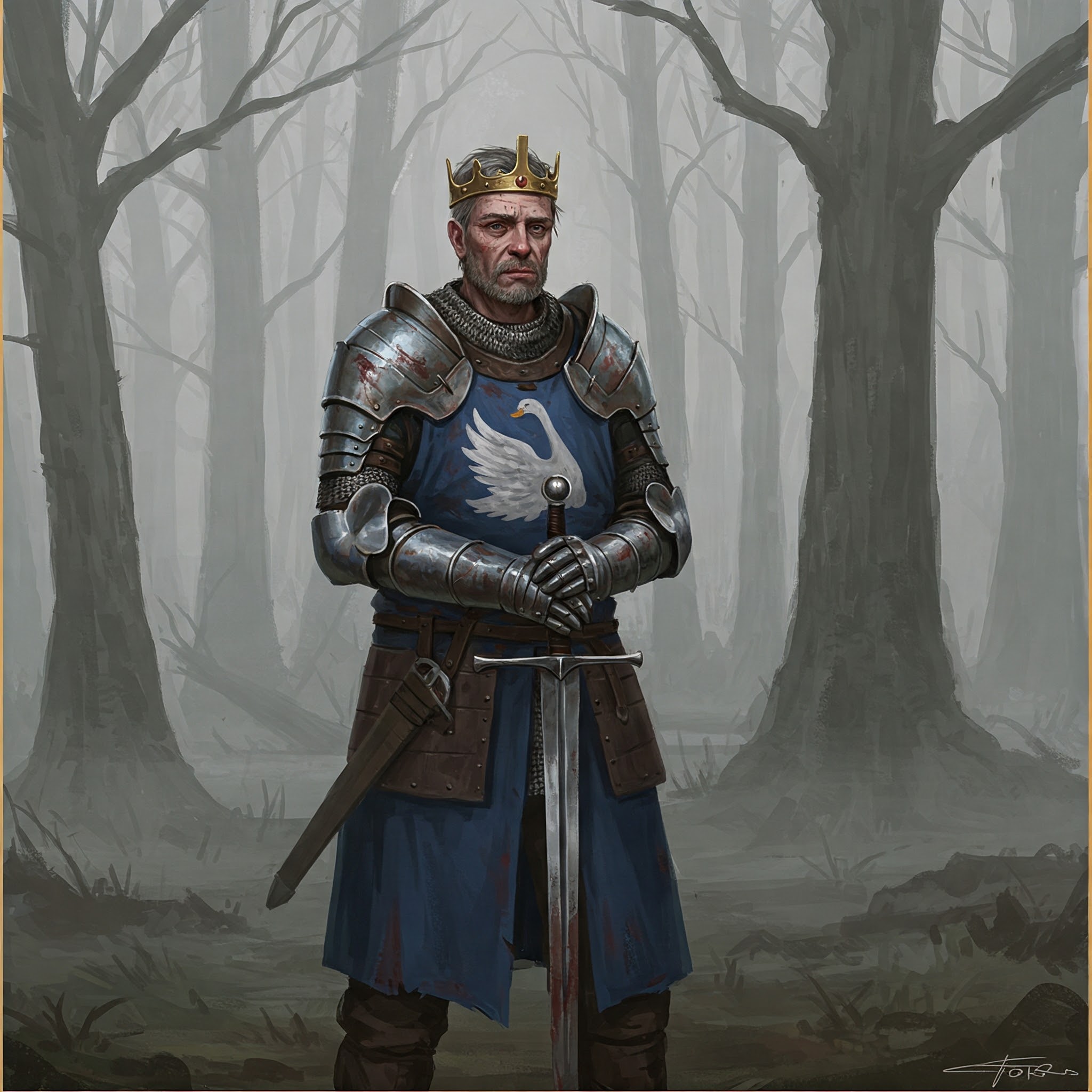
My own realm, centered in the verdant depths of the Forest of Dean, thrives without the need for Uther's protection or his burdensome taxes. My people are content, and our borders are secure. To prove this, I have made a bold statement. In the heart of my city, once known as March4 ZI Flanc de Colline but now increasingly referred to with a different name, I have placed a large circle of gold atop a simple wooden pole in the public square. Unattended. Unguarded.

Many among the other lords believe it will not last a single night, a tempting prize for bandits or ambitious knights. Yet, my own people understand the deeper meaning of this Circle of Gold. It represents the profound trust their king has in them, a testament to the honor and peace that prevails within our native land.

Furthermore, my wife, Queen Elisbeth des Yeux Azur, a woman of formidable intellect and… certain arcane talents, has woven a spell upon the ring. But let it be known, this enchantment is not to protect the gold itself. Rather, it is to aid those who would defend the peace and integrity of our kingdom. The nature of this aid… that remains to be seen by any who would threaten our tranquility.

Thus, while the rest of Britannia descends into civil strife, the Kingdom of the Circle of Gold stands apart, a beacon of self-reliance and quiet strength. I offer no allegiance to Uther, nor do I support the ambitions of Gorlois. We shall chart our own course, secure in our own borders and trusting in the loyalty of our people and the subtle protections that guard our realm.

The path ahead remains uncertain, but one thing is clear: the age of unquestioned High Kingship may be drawing to a close. Perhaps the future of Britannia lies not in centralized power, but in the strength and independence of individual kingdoms, each secure in its own right.

Continue to follow these chronicles, and you shall see how the Kingdom of the Circle of Gold fares in these turbulent times, a testament to a different way of rule.


Tales from the KOG Part 2 Tales of a Rising Star


Tales of a Rising Star - The Knighthood of Fallagantis de la Fontaine


Greetings once more, to whosoever reads these continuing accounts of my family's journey through the ever-shifting tides of Britannia. My name is Fallagantis, son of the venerable Sir George of Hereford, whose own chronicles, I hope, have reached your eyes. The times have moved on since my father first put quill (or perhaps a more primitive digital stylus!) to parchment. The Saxon threat has intensified, and new figures rise and fall in the struggle for dominance.

I myself have risen in station and renown beyond what my father might have imagined in his early years. Through valor in battle, skill at arms, and perhaps a touch of ambition (a trait my father, ever cautious, might have frowned upon!), I have become a knight of some repute.

Let me present my own measure, as it stands in these more… dynamic times:

Fallagantis de la Fontaine - A Knight of Growing Fame

  • SIZ 16, DEX 13, STR 14, CON 15, APP 13
  • Move 3
  • Armor 10 + shield
  • Unconscious 8; Major Wound 15; Knockdown 16; Hit Points 31
  • Healing Rate 3
  • Damage 5d6
  • Glory: A respectable 6,000, a testament to battles won and challenges overcome.  

My skills in combat have broadened and sharpened. While the lance (18) remains a favored weapon, I have also developed a keen edge with the sword (22) and even taken to the axe (15) when the situation demands brute force. My understanding of Battle (18) has deepened through command, and my Horsemanship (18) allows me to maneuver effectively on the ever-changing battlefield.

The demands of our era require more than just martial prowess. Awareness (13) keeps me vigilant against treachery, Courtesy (13) is essential in navigating the intricate web of alliances and rivalries among the British lords, and First Aid (13) remains a vital skill for any leader of men. Heraldry (13) helps me understand the shifting loyalties of banners, Hunting (13) still provides for my household, and the Tourney (13) offers a proving ground for my skills.

My spirit burns with a Valorous (16) fire, a trait I believe I inherited from my father, though perhaps tempered with a bolder edge. My Passions drive me – though I shall not delve into their specifics here, suffice to say they burn with an intensity (at least 16, in several key areas) that shapes my decisions and my path.

My warhorse remains a powerful Charger (6d6), a symbol of my station. And in these times, a knight's attire speaks volumes; I favor Rich clothing (£4) befitting my growing status.

The land continues to be contested. The Saxon tide shows no sign of receding, and the ambitions of various British kings often lead to internecine conflict. It is in this environment that my own fortunes have risen. Through service to my liege (in whose name I shall not yet fully reveal), I have distinguished myself in numerous skirmishes and battles against both Saxon invaders and rival British factions.

My adventures have taken me through the shadowed depths of the Forest of Dean, a place of ancient mysteries and lurking dangers. There, I have faced beasts both natural and perhaps… unnatural, honing my skills and adding to my growing Glory. The whispers of a unique challenge within that forest, a Circle of Gold, have also begun to reach my ears, a test of worth that some knights dare to undertake.

The future remains unwritten, but I feel a sense of destiny drawing me forward. The old ways clash with the new, and the fate of Britannia hangs in the balance. I, Fallagantis de la Fontaine, intend to play my part in shaping that destiny.

Continue to follow these chronicles, and you shall witness the further rise of my house and the unfolding drama of our age.


Tales From the KOG - Part 1 - Our Saga Begins!


Excellent! Let's rewind the clock and begin our retro-blog series with your grandfather, Sir George of Hereford, as if he were just starting his own online chronicle back in the early days of the internet (or perhaps a very enthusiastic Usenet post!).

Tales From the Early Days - The Knighthood of Sir George

A Missive for the Ages - From Sir George of Hereford


Greetings, fellow adventurers and seekers of tales in ages yet to come! Should these humble words survive the ravages of time and find their way to your curious eyes, know that they are penned by George of Hereford, a knight who lived in the twilight of Roman Britain, when the echoes of empire still lingered amidst the rising clamor of a new age.


Imagine, if you will, a land wrestling with its identity, where crumbling villas stand as silent witnesses to a lost grandeur, and the shadow of the Pictish raiders stretches long across the northern hills. It is in this crucible that our story, the story of my lineage, begins.


I, George, was not a knight born to great fortune, but rather one forged in the fires of service. Years I spent as a man-at-arms, learning the grim dance of battle and the unwavering necessity of loyalty to one's lord. When the spurs were finally mine, they were earned through hard-won experience, not inherited privilege. Some, in their jesting, even called me "Old Knight" from the outset, perhaps sensing the weight of years I already carried.

It is the year of our Lord, perhaps some sixty or seventy winters since the great Emperor Honorius bid farewell to our shores. Britannia is a patchwork of petty kingdoms and ambitious warlords, each striving for dominance in the vacuum left behind. My own lord, Count Reginald, a man of stern virtue and unwavering loyalty to the nascent British crown (currently worn, however precariously, by the noble King Constantin), strives to maintain order and defend our lands against the encroaching darkness.

My own journey into knighthood was not one of swift ascent. Many years did I serve as a man-at-arms, learning the harsh realities of war and the importance of a stout shield and a well-honed blade. Yet, through diligence and a modicum of valor (a trait I strive to cultivate, though some whisper I am more… cautious), I was deemed worthy to take the oath and bear the spurs of a knight.

Allow me to present myself as I was in those early days, a testament to the challenges and the modest triumphs of a knight in a fractured land:


Sir George of Hereford - A Chronicle for Future Eyes


SIZ 11, DEX 8, STR 11, CON 11, APP 8

Move 2

Armor 10 + shield

Unconscious 5; Major Wound 11; Knockdown 11; Hit Points 22

Healing Rate 2

Damage 4d6

Glory: A hard-earned 2,500, each point a story in itself.

My skills lie primarily in the martial arts, as befits a knight of my station: Dagger (10), Lance (18 - a skill I confess to some pride in), Spear (10), and Sword (20 - my trusty companion in many a fray). I have also learned the necessities of Battle (18) and Horsemanship (18) to serve my lord effectively.

Beyond the clang of steel, I endeavor to uphold the virtues of a knight. Awareness (15) keeps me vigilant, Courtesy (15) aids in dealing with my peers (though my Appreance, alas, is but middling), and First Aid (15) is a grim necessity on any battlefield. Heraldry (15) allows me to discern friend from foe, Hunting (15) provides sustenance and sport, and Tourney (15) keeps my skills sharp in times of peace.

My heart holds a strong Loyalty (15) to Count Reginald, a bond forged in shared hardship and mutual respect. And though age may weigh upon my limbs, my spirit, I hope, remains Valorous (1d6+12).

My destrier, a sturdy Charger of middling size (6d6), has carried me faithfully through many campaigns.


These early years are marked by the slow but steady spread of the Christian faith, a matter of much debate and occasional conflict. The whispers of strange heresies and the clash between the old ways and the new often lead to unrest. Furthermore, the Saxon menace on the eastern shores grows ever bolder, their longships bringing fierce warriors who seek to claim our lands for their own.

The very fabric of Britannia was changing in those days. The whispers of a new faith, Christianity, echoed through the land, sometimes bringing solace, sometimes strife. And from across the sea, the longships of the Saxons brought a relentless tide of invaders, their eyes set on claiming our ancestral lands.


My service to Count Reginald saw me ride against the savage Picts, Pictish raiders from the north, patrol the Roman roads now falling into disrepair, and stand shield-to-shield in the retinues of ambitious kings. Each duty performed, each threat repelled, added to that intangible yet vital measure: in minor skirmishes against rival British chieftains. Each deed, each successful defense, adds a little more to my Glory, a measure of a knight's worth in these tumultuous times. It was upon this foundation, upon the deeds of a humble knight in a turbulent age, that the future of my family would be built, a future I could scarcely imagine as I dipped my quill in ink by the flickering light of a campfire.


The path ahead is uncertain, but a knight must do his duty. I shall endeavor to record further tales of my service and the unfolding events in Britannia as time and circumstance allow. May this humble chronicle serve as a testament to the struggles and the nascent heroism of our age.

May this account serve as a testament to the dawn of a new era, and the role of a simple knight within it.

Farewell for now, until the next turning of the page, from George of Hereford, a knight of the early days.